CB750 Prototype
The CB750 Prototype
This story is the translation of an article published in Japan describing Robert Brooks of California and his, reputed, CB750 prototype. Later information suggests that this bike is a modern replica of the prototype bikes that made the rounds of west coast dealers in 1968. Thanks to Joe Broussard and Munekazo Shimizu, SOHC/4 #256 for the original article.
2026 update: The translation was updated with the help of Google Gemini.
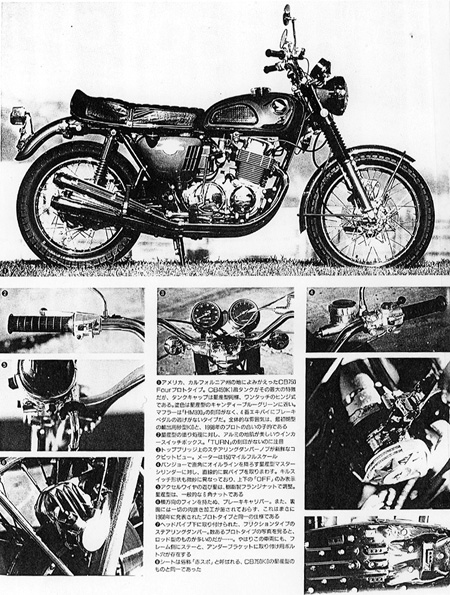
This text describes a rare prototype of the legendary Honda CB750 Four. It highlights several "pre-production" features that differ from the mass-produced models we know today.
Here is the translation of the numbered descriptions:
1. Overview
A CB750 Four prototype that resurfaced in California, USA. The CB450K1 fuel tank is its most striking feature, though the tank cap is the same one-touch hinge type found on production models. The paint color is close to the production "Candy Blue Green." The mufflers lack the "HM300" stamping, and there is no cutout in the #4 exhaust pipe for the brake pedal. The overall aesthetic is a mix of the very early export K0 and the 1968 prototype.2. Switchgear
Unlike the painted production housings, this features a raw aluminum finish on the turn signal switch box. Note that it lacks the "TURN" engraving found on later models.3. Cockpit
A view of the cockpit showing the steering damper knob on the top bridge. The speedometer is a 150 mph full-scale gauge.4. Master Cylinder
Unlike the production master cylinder, which has oil lines exiting at an angle via banjo bolts, this one uses straight metal pipes. The shape of the kill switch is also slightly different, and it features "OFF" markings on both the top and bottom.5. Throttle Adjustment
The throttle play is adjusted using a brass flange nut. On mass-produced models, a standard hexagonal nut is typically used.6. Front Brake Caliper
A brake caliper without horizontal cooling fins. Furthermore, the back of the caliper has no casting marks or machining. This is the exact same specification seen on the prototype announced in 1968.7. Steering Damper
A friction-type steering damper mounted under the head pipe. While many prototypes used rod-type dampers, this vehicle has a stay on the frame side and mounting bolt holes on the under-bracket.8. Seat
The seat is the so-called "Red Sponge" type, which appears to be identical to the early mass-production CB750K0 seats.

This second page continues the deep dive into the "Phantom" Honda CB750 Four Prototype, focusing on the engine, frame details, and unique markings.
The title at the top reads: "The Phantom HONDA CB750Four Prototype"
1. Side View & Frame
Looking from the left, you'll notice the horn is not the thin production type. The main stand has a grip that extends forward from the suspension point. While some side covers on 1968 prototypes were integrated with the air cleaner or lacked ventilation slits, the ones on this bike are closer to the mass-production style.2. Oil Filter Cover
The so-called "no-fin" oil filter cover. This is a representative part of the very early "sandcast" engines.3. Oil Tank Cap
The top of the dry-sump oil tank cap has a single-line (slotted) knob. Production models have a flat shape with knurling around the edges.4. Tires & Fenders
The tires have a different groove pattern than production models. These are Dunlop K77s, as used on the 1968 prototype. The fender edges are not rolled inward, making it a so-called "cut fender."5. Carburetors
While the 1968 prototype was reportedly equipped with "CR" type carburetors, this vehicle is fitted with Keihin PW28 carbs, the same as the mass-production models.6. Tank Emblem & Engine Details
It features the "Round" Honda Wing emblem on the tank (upper right), which was never used on mass-production bikes—a definitive prototype feature. Also, the cooling fins on the cylinder head don't protrude past the bottom fin, a characteristic of the earliest sandcast K0s. The oil lines for the sump tank are the cloth-wrapped type rather than the common mesh-covered ones.7. & 8. Serial Numbers
- Engine No. 1000037
- Frame No. 1000035
From these extremely low numbers, it is clear that this is a very early, historically significant CB. This bike is essentially the "missing link" between the hand-built show bikes and the early sandcast production run.

This third page provides the backstory of how this specific bike was discovered and its historical context. The bold text in the top right corner translates to "EXCAVATION" (or "Discovery").
Resurrection from the Junkyard
In the suburbs of Los Angeles, California, Robert Brooks—owner of a bike shop called "Bike's Russ" and a major motorcycle enthusiast—spotted a strange CB750 Four in a junkyard. While its condition was far from good, it was unlike any CB he had ever seen. That’s because the bike he found was a prototype that was never supposed to have survived.
As a dedicated enthusiast, Robert was aware of the 1968 prototypes featured in Japanese magazines and the "camouflaged" versions equipped with CB450K1 tanks that were tested on Honda’s test courses along the Arakawa River just before the official launch. Now, the real thing was right in front of him.
He immediately began negotiations with the junkyard owner. Whether the owner knew the bike's true value or not, he was initially unwilling to sell. Robert visited repeatedly until his persistence finally paid off and the owner agreed to sell.
The new owner has since restored this CB750 prototype down to the very last bolt using 100% genuine Honda parts. He even went so far as to use bolts stamped with the number "8," a detail famous among CB750 Four enthusiasts. The paint and various finishes have been faithfully recreated to original prototype specs.
The Historical Mystery
What makes this vehicle particularly interesting is that while it is loaded with prototype-specific parts, some mass-production parts are also integrated. According to "Honda News" dated July 28, 1969, exports of the CB750 Four to North America began in April, with sales starting in July of that year.
Surprisingly, this vehicle’s original registration documents still exist, showing a registration date of June 1969. This is significant because by the spring of that year, Honda had already held press launches in Japan for the final mass-production version (the style we now know as the "K0").
According to information gathered from the junkyard and other networks, it is believed this CB prototype was likely used as a demonstration unit for major dealers in North America prior to the official release. While its exact origins remain unconfirmed, it is a known piece of Honda history that prototype testing was conducted across North America throughout 1968. It is a famous episode in Honda lore that under Soichiro Honda’s leadership, specifications were often changed right up until the very moment of release.
Captions
Top Image: A 1968 prototype running on the Arakawa test course. It uses a CB450K1 tank and drum brakes. Just before the Tokyo Motor Show, it was fitted with a front disc brake. The tank appears to have measuring equipment mounted on it, and the compact AC generator (ACG) is a characteristic of this period.
Small Center Image: Another shot of the test bike, highlighting the use of a fairing during testing—a hint at the CB's high-speed touring intentions.

This final page concludes the story of the "Phantom CB" with a comparison of models and a look at the team that restored it.
The "Phantom" CB750 Four Prototype
Top Comparison Photos:
Left: The prototype announced in 1968.
Right: The 1969 CB750 Four (K0) mass-production model.
Caption text: Codenamed "Dream HM300," the development of this benchmark machine began in the spring of 1968. Over a incredibly high-speed development period of just one year, various prototypes were born and then vanished. Traces of these prototypes can even be seen in early export brochures.
The Future of the Machine
Based on the evidence, we can infer that this "phantom" CB is one of the few prototypes born during the development process that managed to survive.
Bob of "Bike's Russ" has many connections with Japanese businesses. He plans to establish an office in Japan next year. Furthermore, he intends to exhibit this legendary Honda CB750 Four prototype at the Classic & Custom Motorcycle Fair held in Harumi, Tokyo, starting January 21st.
Japan is home to many fanatical CB enthusiasts. Apparently, some have already tracked him down to ask if he would sell this prototype. However, the owner’s current intention is that he does not want to sell it to a private individual if possible.
After the show, it is undecided whether the bike will stay in Japan or return to America. However, Bob’s personal hope is to lend it to Honda Motor Co., Ltd. so it can be displayed in their Collection Hall (at Twin Ring Motegi). He mentions that, interestingly, the K0 currently in the Honda Collection Hall is actually a later production model.
This is a truly selfless proposal. Bob deeply respects the late Soichiro Honda, and he believes that preserving this bike in its best form is the right path for a true Honda enthusiast. In the world of vintage motorcycles, where stories often quickly turn to gossip about money, his pure passion is truly admirable. One thing is for certain: seeing this actual machine in person will be a thrill.
The Evidence & The Team
Bottom Left (Title Document): A photo of the Ownership Certificate. The date is clearly visible as June 16, 1969. Whether it was registered by a private individual or Honda's US headquarters for a dealer remains a mystery. Regardless, it is now safely under the care of the "Bike's Russ" staff. The third person from the left in the group photo is the owner and dedicated Honda enthusiast, Robert (Bob) Brooks.
Summary of the "Phantom" Features
If you are looking at a bike and see these specific things, you're looking at a prototype:
CB450K1 Gas Tank (with the knee pads).
Round Wing Tank Emblem (rather than the "HONDA" script).
Smooth "No-Fin" Oil Filter Cover.
Metal Pipe Brake Lines at the master cylinder.
Friction Steering Damper under the headstock.
It’s a amazing piece of history—Bob’s dream of getting it into the Honda Collection Hall shows just how special this specific VIN (#35) really is!